
ARTICLE 1
THE REPUBLIC OF TAJIKISTAN IS A SOVEREIGN, DEMOCRATIC, LEGAL, SECULAR, AND UNIQUE STATE.
Capital — Dushanbe
Geographical location — The Republic of Tajikistan is located in the southeastern part of Central Asia.
Area — 141,379 km²
Population — 10.3 million people
National currency — Somoni
Tajikistan is a land of mountains, clear waters, and unique nature. It is situated in the heart of Central Asia and shares borders with Uzbekistan, Kyrgyzstan, China, and Afghanistan. Mountains cover 93% of the country’s territory. Ismoil Somoni Peak, with a height of 7,495 meters, is one of the highest peaks in the world.
The country is known for its abundant water resources and beautiful nature. Rivers and lakes of Tajikistan are the main source of water resources in the region. There are more than 1,300 lakes in the country, the most famous of which are Sarez and Khovarkul.
The flora and fauna of Tajikistan are very diverse. Forests are rich in fruit trees and medicinal plants. Rare animals inhabit the mountains, including the snow leopard, argali, deer, and bear.
To protect these natural resources, the republic has 4 nature reserves, 13 nurseries, and the National Park of Tajikistan, which together cover more than 21% of the country’s territory.
.
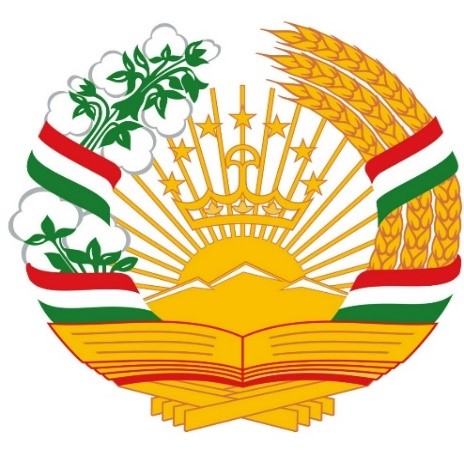 | STATE EMBLEM OF THE REPUBLIC OF TAJIKISTAN |
The emblem of the Republic of Tajikistan is used in color, monochrome, or black-and-white versions.
ELEMENTS OF THE STATE EMBLEM OF THE REPUBLIC OF TAJIKISTAN
(Adopted by the decision of the Majlisi Namoyandagon of the Majlisi Oli of the Republic of Tajikistan on March 14, 2007, No. 500 “On the Approval of the State Emblem of the Republic of Tajikistan”)
The State Emblem of the Republic of Tajikistan consists of an image of a wreath, a semicircle, on which seven stars illuminate the sun rising from behind snow-capped mountains, surrounded on the right by wheat ears and on the left by flowering cotton branches. The upper part of the wreath is wrapped with a ribbon in red, white, and green stripes, and at the bottom, above the ribbon, there is an open book.
The emblem is colored as follows: the wreath, sun, mountains, wheat ears, and book-plank are gold; cotton leaves are green; ribbon stripes are red, white, and green; the book cover is red.
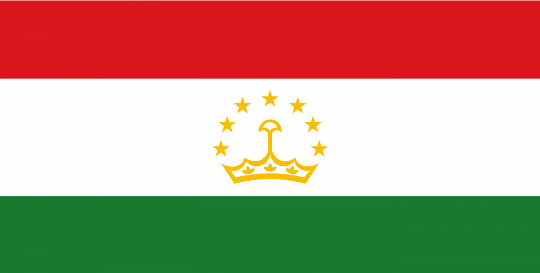 | STATE FLAG OF THE REPUBLIC OF TAJIKISTAN |
ELEMENTS OF THE STATE FLAG OF THE REPUBLIC OF TAJIKISTAN
(Adopted by the decision of the Majlisi Namoyandagon of the Majlisi Oli of the Republic of Tajikistan on March 14, 2007, No. 499 “On the Approval of the State Flag of the Republic of Tajikistan”)
The state flag of the Republic of Tajikistan is a rectangular cloth with three horizontal stripes: the top stripe is red, the middle stripe is white, and the bottom stripe is green. The width of the top red stripe is equal to the width of the bottom green stripe, and the width of the white stripe is one and a half times the width of one of the colored stripes.
In the center of the white stripe, there is a golden crown with seven stars arranged in a semicircle. The overall proportions of the flag are 1:2 (height to length).
The crown and stars are placed within a rectangular area: their vertical height is 0.8, and horizontal width is 1.0 of the white stripe’s width. The five-pointed stars have a diameter of 0.15 of the white stripe and are positioned in a semicircle with a radius of 0.5 of the white stripe’s width.
The height of the crown is 0.55 of the white stripe’s width and is curved upward in a semicircle with a radius of 1.2 of the white stripe’s width. Four arc-shaped elements forming the top of the crown are connected at the center by a circle with a diameter of 0.2 of the white stripe’s width.
MAIN TOURIST DESTINATIONS IN THE REPUBLIC OF TAJIKISTAN
The territory of Tajikistan covers 141,379 km², 93% of which is mountainous. In the east lies the Pamir — the “Roof of the World” — with glaciers and unique lakes such as Sarez, Khovarkul, Yashilkul, and Bulunkul. The foothills of Fan and Archamydon, Shokhambar, Karotegin, and Darvoz, with their fairy-tale landscapes, enchant tourists. The valleys of Hissar, Rasht, Zarafshan, and Varzob attract nature lovers and hikers with their lush greenery, rivers, and pristine lakes.
Historical and cultural attractions:
Sarazm, one of the oldest cities in the world, is included in the UNESCO World Heritage List. Panjakent is the center of classical Persian-Tajik literature and the birthplace of the great poet Abuabdulloh Rudaki. The fortresses of Hissar, Hulbuk, Yamchun, Karon, and Vamar testify to the times of emirs and kings. The mausoleum of Mir Said Ali Hamadani in Kulob and the “Chiluchorchashma” site in Shahritus symbolize the country’s historical and cultural heritage. The National Museum of Tajikistan, the National Library, and cultural parks reflect the nation’s history and culture. The National Park, Rudaki Park, Park Parcham, and Kokhi Navruz serve as cultural and recreational centers and symbols of tourism development.
Natural and tourist attractions:
The Romit and Zorkul reserves and the Pamir Botanical Garden are attractive for eco-tourists and nature enthusiasts. The Shing River, Marguzor and Iskanderkul lakes with picturesque waterfalls, and the Hissar and Pamir mountains are ideal for hiking, skiing, and rafting. Healing springs such as Zairon, Obi Shifo, Tandiqol, and Khodja Obi Garm are designed for wellness and recreational tourism. Agro-tourism with vineyards, peach, and apricot orchards provides opportunities for gastronomic tourism.
Special attractions:
Hunting for rare animals — Marco Polo sheep, ibex, and brown bears. The National Park of Tajikistan covers 2.6 million hectares and hosts rare flora and fauna. Winter tourism at the Sapedara ski resort and snowboarding parks with modern infrastructure attracts sports enthusiasts. National holidays and gastronomy — Navruz, Mehrgon, Sada, Tirgon, and traditional dishes — enhance gastronomic tourism.
Tajikistan is a country where every peak, river, lake, and fortress tells its own story. From wild nature to ancient museums, from crystal-clear waterfalls to cultural parks, the country offers a unique tourist experience and invites visitors to discover its enchanting destinations.